
Tissue-cultured in the Netherlands · Shipping across Europe

€ 34,99
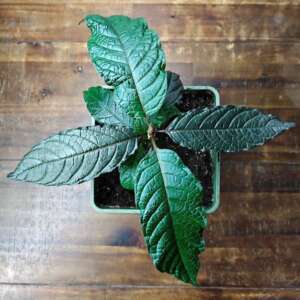
Kava or kava kava (Piper methysticum: Latin ‘pepper’ and Latinized Greek ‘intoxicating’) is a plant in the pepper family, native to the Pacific Islands. The name kava is from Tongan and Marquesan, meaning ‘bitter’. Kava can refer to either the plant or a psychoactive beverage made from its root. The beverage is a traditional ceremonial and recreational drink from Polynesia, Micronesia, and Melanesia. Nakamals and kava bars exist in many countries. Traditional kava is made by grinding fresh or dried kava root, mixing it with water or coconut milk, and straining it into a communal bowl.
Available on backorder
Kava or kava kava (Piper methysticum: Latin ‘pepper’ and Latinized Greek ‘intoxicating’) is a plant in the pepper family, native to the Pacific Islands. The name kava is from Tongan and Marquesan, meaning ‘bitter’. Kava can refer to either the plant or a psychoactive beverage made from its root. The beverage is a traditional ceremonial and recreational drink from Polynesia, Micronesia, and Melanesia. Nakamals and kava bars exist in many countries. Traditional kava is made by grinding fresh or dried kava root, mixing it with water or coconut milk, and straining it into a communal bowl.
Kava consists of sterile cultivars clonally propagated from its wild ancestor, Piper wichmanii. It originated in northern Vanuatu, where it was domesticated by farmers around 3,000 years ago through selective cultivation. Historically, the beverage was made from fresh kava; preparation from dry kava emerged in response to the efforts of Christian missionaries in the 18th and 19th centuries to prohibit the drinking of kava.
Kava was historically grown only in the Pacific islands of Hawaii, Federated States of Micronesia, Vanuatu, Fiji, the Samoas, and Tonga. It appears to have originated in Vanuatu; an inventory of P. methysticum distribution showed it was cultivated on numerous islands of Micronesia, Melanesia, Polynesia, and Hawaii, whereas specimens of P. wichmannii were all from Papua New Guinea, the Solomon Islands, and Vanuatu.
Traditionally, plants are harvested around four years of age, as older plants have higher concentrations of kavalactones. After reaching about 2 meters in height, plants grow a wider stalk and additional stalks, but not much taller. The roots can reach a depth of 60 centimeters.
We use cookies to improve your experience on our site. By using our site, you consent to cookies.
Manage your cookie preferences below:
Essential cookies enable basic functions and are necessary for the proper function of the website.
These cookies are needed for adding comments on this website.
Statistics cookies collect information anonymously. This information helps us understand how visitors use our website.
SourceBuster is used by WooCommerce for order attribution based on user source.
Reviews
There are no reviews yet.